Secure, reliable deployment choices for Industry 5.0 manufacturing - with controlled cloud and internal-network operating models.
For manufacturers, enterprise readiness is not just about features. It is about whether a platform can fit real plant conditions: segmented networks, strict security controls, mixed machine environments, and dependable operation without exposing production systems to the public internet. SAGE is designed to support those requirements through flexible deployment choices and strong control over data movement.
Four Deployment Choices for Customer Environments
-
Main server deployment
- Install SAGE directly on the customer's main server.
- Pull approved machine data and internal system data into one central environment.
- Good fit for a compact architecture with fewer moving parts.
-
Separate orchestration server
- Run SAGE on a dedicated server that orchestrates movement between machines and the master node.
- Provides cleaner separation of duties and stronger workload isolation.
- Allows orchestration to scale independently of the data store.
-
Isolated VM inside customer network
- Deploy SAGE on a tightly controlled virtual machine inside the customer network.
- Inbound access only from approved internal systems.
- Outbound access blocked except to approved internal endpoints, with no public internet route.
-
AWS private cloud deployment
- Deploy SAGE in AWS using private networking patterns and controlled access.
- Use private or VPN-only subnets, private connectivity, and bastion-style administration.
- Supports cloud flexibility without broad public exposure of core workloads.
Keeping Customer Data Inside Controlled Boundaries
In on-premises and VM-based deployments, data movement happens entirely within the customer's internal network. Machine endpoints send data to a local SAGE instance or approved internal server, and synchronization occurs only between internal endpoints. No public internet route is required for the architecture to function.
In AWS, the same principle can be preserved through a customer-controlled cloud boundary. SAGE can run in private or VPN-only subnets connected back to the plant through Site-to-Site VPN or Direct Connect. This allows the application and data layers to remain outside public internet exposure while still benefiting from cloud scalability and operational control.
Security by Architecture, Not Just by Policy
- Encryption in transit protects data as it moves between approved internal endpoints and controlled cloud boundaries.
- Network segmentation and allowlisted ports limit communication paths to only what is required for operation.
- Least-privilege access can be applied to users, administrators, and service identities.
- Audit logging gives customers visibility into administrative actions, transfer activity, and operational events.
Reliable by Design
- Controlled retries and resumable transfers help maintain continuity during routine operational interruptions.
- Local buffering and store-and-forward patterns support environments where communications may be bursty or scheduled.
- Centralized monitoring and logs improve observability for IT, plant engineering, and operational support teams.
- Separate orchestration and data-handling tiers can be isolated for performance and scaling as requirements grow.
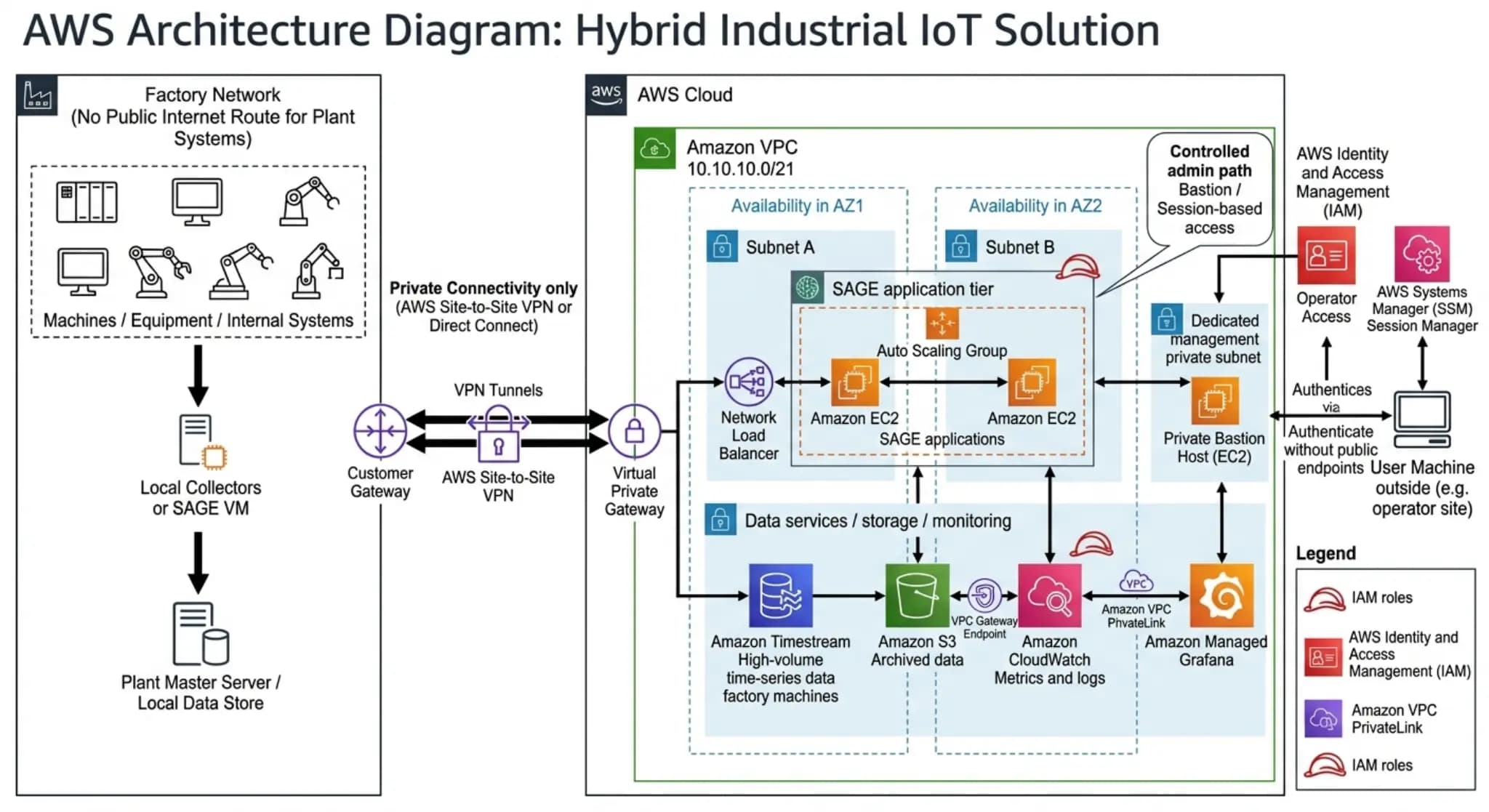
Reference Cloud Architecture (Conceptual)
This conceptual model shows the core principle behind SAGE architecture: collect and synchronize data close to the source, keep production systems inside approved network boundaries, and extend to cloud only through private, customer-approved connectivity.
- Factory network (no public internet route): Machines/equipment/internal systems connect to Local collectors or SAGE VM, which route to a Plant master server / local data store.
- Private connectivity only: Connection via AWS Site-to-Site VPN or Direct Connect.
- AWS customer environment: Amazon VPC with private or VPN-only subnets containing the SAGE application tier and Data services / storage, protected by security controls like private subnets, allowlisted ports, least privilege, and audit logging.
Why This Matters for Industry 5.0
Industry 5.0 readiness depends on digital capabilities that are resilient enough for production environments, secure enough for enterprise governance, and practical enough for plant teams to trust. SAGE supports that by offering flexible deployment choices, internal-network operating models, and secure cloud options that do not compromise architectural discipline.
Stay Updated with Our Newsletter
Join our community and receive the latest insights, tips, and exclusive content directly to your inbox.